Courtesy of Omni TV Toronto - please wait a few moments for video to load
fFIDA Festival 2005
 
To engage Vox Dance Theatre,
or request a press kit or extended videos,
call: 310-403-6134
email: sarahvox@earthlink.net.
Please specify hardcopy or electronic.


The Vox Dance Theatre Newsletter
September 2011 Vol. 1 No.1          

UPCOMING BENEFIT PERFORMANCE, SEPT. 17, 2011

Vox Dance Theatre is planning a benefit performance to take place from 7:00 to 9:00 PM on Saturday, September 17, 2011 at the Japanese American Cultural & Community Center, ground-floor Gallery. 244 S. San Pedro Street, Los Angeles, CA 90012. Light refreshments will be served.

The program for the evening will include a sneak preview performance of the company's upcoming "Fimmine in Kimono," which will be performed in its entirety on October 16, 2011 as part of the Los Angeles's World Festival of Sacred Music Celebration. Also, a duet has been choreographed by Sarah Swenson for herself and Board Member and dancer, choreographer, and educator, Jeff Slayton, especially for the evening. Additionally, teen dancers from the Colburn School of Professional Training Program, and the LAUSD All District Dance Ensemble, will perform.

Brief comments will be presented by Kathleen Selke, a former (founding) member of Vox Dance Theatre, and by Board Members Cheryl Banks Smith and Jeff Slayton, as well as the perspective of one of the Colburn School students. Artistic Director Sarah Swenson will also speak about the mission, vision, and future of the company.

We hope that you will mark your calendars and join us for this exciting celebration of Vox Dance Theatre. Tickets are $40.00 and may be purchased at the door or online, here


VOX DANCE THEATRE WORKS WITH LAUSD ALL DISTRICT DANCE ENSEMBLE

This past spring, Sarah Swenson was asked by the Los Angeles Unified School District (LAUSD) to work with a group of high school students on the creation of a piece of choreography. Ultimately, five students were chosen, four girls and one boy, to form the first ever LAUSD All District Dance Ensemble, the brainchild of Shana Habel, LAUSD's Dance Demonstration Teacher. Due to time constraints, Sarah decided not to create an entirely new work. Instead, she chose to re-recreate Movement III of her classic Fimmine, renaming this particular segment in the process and calling it Juventud, meaning “youth” or “youthfulness” in Spanish. According to Sarah, she chose this particular section of work “because it is a challenging piece of choreography on several levels, yet not too complicated.” And, as such, she felt that a dedicated group of young dancers ought to be able to handle its intricacies.

The students, themselves, had the opportunity to audition for the piece. As Ms. Habel says, this decision on their part to audition “showed a great deal of initiative, given that this was the first year an All-District Dance Ensemble has been in existence.” The idea was to give talented and interested students the opportunity to work with a professional choreographer. In so doing, it was hoped that they would take advantage of the opportunity to grow both technically and artistically as dancers, as well as to gain a wider view in general of what dance can be.

As it turned out, the students loved both the process and the end product. Sarah and Shana report that the young dancers were fully engaged and eager to learn, pushing themselves to do what they had never done before. In the process, they also acquired new skills, insights, and a discipline that would serve them well as future dancers, if that may be their career aspiration, or in whatever field they may choose to concentrate later on. Shana was delighted with the outcome, commenting that, “I don’t exaggerate when I say that it was a transformative experience for them. They rose to the occasion with great success and will forever be changed by it.” And as Sarah puts it, “I thought they really matured over the process, and they all became better dancers.”

It was an exciting experience for the students. They loved what they did, and they loved working with Sarah. Again quoting Shana, “She (Sarah) has a gift for working with these young dancers, which was apparent and wonderful to see.” After weeks of rehearsal, Juventud was finally presented at the district concert. It was one of the favorite works on the bill and a “cornerstone” of the concert. Shana reports audience members saying that they thought it was “amazing,” and that, “it looked like a professional company.”

As one of the central works of Sarah Swenson’s choreographic opus, Fimmine has been lauded by many over the years. However, this was one of the few times that it has been set on dancers as young as the LAUSD students. There now seems no doubt that this was not only a successful experiment, but a wonderful experience both for the students and for the audience that viewed the performance.


"At The Feet Of The Masters"

Cheryl Banks-Smith Responds to Vox Dance Theatre’s SUMMER NIGHTS CLASSICAL DANCE EDUCATION SERIES

During the past 7 weeks, from June 16th to July 28th I spent my Thursday evenings at Brockus Project Dance Studios taking a series of Master Classes taught by some of L.A.’s seminal dance artists and teachers. The Summer Nights Classical Modern Dance series, organized and curated by Vox Dance Theatre’s artistic director, Sarah Swenson, was a rare gift to our Southern California dance community. It was an opportunity to explore the techniques of many of our historic modern dance pioneers and to become acquainted with our own living treasures, those dancers right here in our own back yard who trained with and performed in the companies of Graham, Cunningham, Dunham, Farber, Lewitzky and Taylor, and who are the direct repositories of our modern dance heritage. The master teachers were as follows: Trina Parks, Katherine Dunham Technique; Susan McLain, Martha Graham-based Technique; Diana MacNeil, Bella Lewitzky Technique; Jeff Slayton, Viola Farber Technique; John Pennington, Bella Lewitzky Technique; Tamsin Carlson, Merce Cunningham Technique; and Sharon Kinney, Paul Taylor-based Technique. Several of the classes were supported by live musical accompaniment with Eric Ruskin and Norman Beede on piano, and Aaron Perez on percussion. Although the classes were small in attendance, the energy and joyful expression was BIG! I’ll share a few highlights from my own experience of each class.

The first class with Trina Parks was one of the largest attended. It was also unique since we women dancers worked with full skirts during our movement sequences across the floor. The use of the flowing skirts added drama and a feel for the undulating articulation of the spine and hips so typical of Dunham’s movement vocabulary. My favorite moments were watching Trina spontaneously move into an ecstatic eruption of her spine rolling or hips vibrating, slipping into what I called a “hallelujah shout”! She would veer and weave across the space in a moment of abandon, and the image of the Haitian ritual ceremonies that some of Dunham’s dances were informed by would flash into my memory. It was as if Trina was sharing with us a piece of Dunham’s process, blending the demands of an articulate and precise technique with the element of surrender and abandonment. The movements she gave us stressed bent knees folding into gravity, isolations of body parts, poly-rhythms, and combinations of undulating turns and jumps, all done while sashaying a billowing skirt. It was a fun and challenging time.

One of my favorite classes was that of the late Susan McLain, who suddenly and so sadly passed away about five weeks later. Listening to Susan share her personal memories of Graham with such reverence and appreciation was magical. With every exercise or movement phrase that she gave, out would come a story, an anecdote or image that Martha herself would describe, giving insight into what fascinated and inspired her. Susan recalled for us that Martha described dancers as “divine normals”. As we experienced some of the floor work in Graham’s technique, Susan emphasized Graham’s idea of the pull of opposing forces that the spiraling use of the back and the pelvis, the contraction, (giving into gravity) and release, (expanding into all dimensions of the space) was all about. She taught us a few brief excerpts from one of Graham’s signature works, Clytemnestra, a section that included a turning spiral with hops and archaic hands placed precisely over the face and mouth. Eric Ruskin’s exuberant and stately piano was a perfect musical match and lifted my spirits throughout the class. We also explored a phrase across the floor with a complex odd-metered rhythm. Susan explained that Martha loved folk dances for their intricate rhythmic variations. There were so many pearls of wisdom that were shared during this class, but what I valued most was the experience that Susan gave us during and throughout her class, demonstrating directly how knowledge is passed on from generation to generation, through the words, thoughts and stories of our dance ancestors.

There were two purveyors of Bella Lewitzky’s technique, shared by dancers Diana MacNeil and John Pennington. Diana’s class concentrated on the articulation of the spine, moving from flat back into high curves of the upper spine, shifting through under curves across the floor or diving into lateral turns and suspensions. Many of the interesting but challenging combinations had an added element of surprise through the use of odd and syncopated meters. We also experienced an extensive stretching combination on the floor, like a moving chain of postures that elongated, arched and spiraled throughout the body, flexing and extending in every joint.

John’s class, accompanied by Aaron Perez’s live percussion, gave a sense of the architecture of the body. John has such a clear understanding of space- its volume and lines, and how the body dissects that space. His class is like a cocktail, mixing it all up, from standing plies and spinal articulation, to leg swings across the floor juxtaposed with gliding sweeps of the pelvis through space, followed by off-balance shifts from feet to knees to rolling on the back, and ending in aplomb with a serene slide into first position. I left feeling that I had used all of my parts, every part of my body, brain and moving center. And I felt a little delirious at the end of class from the challenge.

Jeff Slayton’s class, an homage to Viola Farber and a nod to Cunningham too, was an absolute delight to experience. Jeff’s always radiant face, enthusiastic encouragement and his own long and lanky body that moved through many of the exercises with us, in spite of an injured hip, seemed to invoke the spirit of Merce into the studio. It was evident that Jeff was aware of each nuance and detail of the movement progressions that would articulate through multiple dimensions of the spine. Then there were moments of suspension and stillness, from parallel to turned-out and turned-in positions. We shifted from flat back into parallel hinges sometimes landing in a poised arabesque or a turning pitch. We discovered the many opportunities to witness the world when the spine and torso shifts away from center and uprightness, tilting and falling towards and away from the center. We ended with a quick, off-balance leaping phrase across the floor testing our stamina and our ability to organize the body in space. It was grand to feel the collective concentration of the class and to hear Jeff’s encouraging voice, reminding us that dance is about joy and urging us to express that enjoyment through our bodies!

Tamsin Carlson, a member of both Vox Dance Theatre and the Rudy Perez Dance Ensemble, immersed us in the detailed and intricate technique of Merce Cunningham. She explained that the technique is very precisely constructed, beginning in parallel with long reaches to each side and eventually progressing through the supple use of the spine, rolling down, curving, arching, swinging, contracting, spiraling, hinging and dissecting the body and the space through the diagonal, lateral, vertical and sagittal planes. It gave a clue into the detailed and fluid mind of Cunningham whose movement sequences might demand the isolation of every joint and hinge of the body. The technique exercises were often challenging requiring a nimble mind as well as body. A few pieces needed to be broken down into smaller parts in order to understand the logic and process. Tamsin taught us a lovely archaic phrase from one of Merce’s earliest solos, with quirky backwards scoots and turning side tilts. Then we had to negotiate performing it on the opposite side, which sent smoke steaming from my brain in the effort. Our final traveling phrase encircled the space, hopping and leaping with the upper body tilting from front to side/reverse side and to the back. I had to smile at one point in class when Norman Beede’s imaginative piano phrases quoted a tune from jazz pianist Thelonious Monk, which seemed ironically appropriate, as both Monk and Merce were masters of rhythmic quirkiness.

Our final Paul Taylor-based technique class, taught by Sharon Kinney was a fitting way to end the series, since Paul Taylor continues to be a thriving and prolific choreographer whose company in 2011 is celebrating its’ 57th year. Sharon began the class telling us that she had just returned from the American College Dance Festival in Durham, North Carolina, where Paul Taylor was honored for his lifetime of artistic achievement. He and his company were in residence at the festival for three weeks. Sharon, one of Taylor’s original company members, was still bubbling with enthusiasm from the occasion and shared with us a photocopy of Taylor’s current bio from the festival’s Gala Performance program. It gave an impressive account of the unique history of Taylor and the range and scope of his 134 choreographic works created from the 1950’s until the present. With a bit of history and respectful acknowledgement, we plunged right in with leg swings and under curves, moving through the warm-up with level changes, twists, spirals and lots of open, curving Paul Taylor-esque arms and generous lunges. Sharon taught us a wonderful combination that exemplified Taylor’s fluid and versatile approach, pushing through an under curve downstage, then shifting upstage, falling into a side lunge, reversing on the diagonal through another forward swing, ending in a wrap around the body, shooting out into a side lunge, and rotating back to parallel home base, to begin again on the other side. The most enjoyable part of the class for me was learning sections of phrases from Taylor’s Aureole and Esplanade. Learning to quickly travel across the space, shifting directions, changing from runs to hops to gallops, requiring both lightness and grounded-ness, and a sensitivity to the musicality of the phrase, was a total body/mind endeavor. But I was up for the challenge and felt refreshingly exhilarated, carried by the movement and the music. Again, Eric Ruskin’s rhythmic and expansive piano expressions were an added treat. I finished sweaty and exhausted, empty because I had given my all, but full and satisfied.

Surprisingly, the classes were not well attended and that was a disappointment. But fortunately, there may be other opportunities for classes and workshops such as the Classical Modern Dance series to happen again if they are supported by the community. And if my reflections have made you curious and interested, then check out the website of Vox Dance Theatre to read other dancers’ comments from the classes. Leave a comment yourself of encouragement and a commitment to support future classes so that they can be arranged. Many of these treasured teachers are in our community and offer ongoing classes. Find out where and when and support them. Modern dance, like jazz, is a vital part of our American cultural heritage. If we are to cultivate in the 21st century our living legacy of dance here in Southern California, it’s up to us to value and support it so that it will survive and thrive.

Cheryl Banks-Smith
July, 2011


VOICES FROM THE BOARD

Jeff Slayton

Over the past thirty-four years I have watched modern dance companies come and go in southern California. Vox Dance Theatre is one of the few that I feel has a chance to succeed. Not only is the choreography by Sarah Swenson full of beautiful movement, but it possesses sincere drama, images that activate one's imagination, and it is full of surprising twists and turns. I never tire of watching Sarah’s work, as I find something new each time that I see it. For me, this is rare. As a choreographer, Sarah inspires me to take creative risks. As a performer, I wish that I were young enough to join her company in order to perform Fimmine! Vox Dance Theatre should be celebrated wherever dance is presented.

*  *  *  *  *  *  *  *  *

Cheryl Banks Smith

Sarah Swenson was one of the first dancers I met when I returned to the Los Angeles area in early 2000. We met at Cal State Long Beach where she was a graduate student in the MFA program in Choreography and I was about to teach an Intro to Modern dance class for non-dance majors at CSULB. Although we didn’t have much contact, I had the chance to see her graduate thesis concert and admired her experienced eye and quality of craftsmanship in her choreography. Intermittently I witnessed some of Sarah’s passionate dancing in various festivals and concerts around town over the years. But it wasn’t until recently that I saw the company perform their signature work, Femmine and an excerpt from a newer work, Brigantesse that I felt moved enough to reach out to Sarah to assist her in getting her work out there, because I feel that the work is exceptional and worthy of support. When Sarah asked me to join the Board of Directors for Vox Dance Theatre, I was honored and happy to lend my support in whatever way I can so that Sarah’s artistic and educational dance work will continue to grow and thrive.

What I especially appreciate about her choreography and the thread of her work is its connection with the classic modern dance tradition. It’s contemporary, and of this day, but has the sense of being grounded to the classical modern dance lineage. Not only is there luscious movement, but also dancers who are able to express complex emotions through their unraveling story telling and through the inherent emotional texture of the movement vocabulary. The works are about something that touches me viscerally, makes me feel, remember, think, recognize a familiar sensation within. Mostly, I love Sarah’s work because it connects me to my own sense of delight in movement and leaves me satisfied.


MARK YOUR CALENDARS - OCT. 16, 2011 - VOX DANCE THEATRE PART OF WORLD FESTIVAL OF SACRED MUSIC

On Sunday, October 16, 2011, Vox Dance Theatre will perform as part of Los Angeles’ multifaceted and multi-cultural World Festival of Sacred Music. The venue will be the Plaza of the Japanese American Cultural & Community Center (JACCC), located at 244 S. San Pedro Street, Los Angeles, 90012. Artistic Director Hirokazu Kosaka has invited the company, as well as several other groups and individual artists, to be part of a program called Mare Vaporum, meaning “Sea of Vapors”. It is named after a dark plain on the south side of the moon, reflective of “our personal journeys toward purity in the darkness of the night”. Kosaka comments that the idea of the event is to blend “traditional Japanese rites of purification with classic contemporary Western sensibilities.”

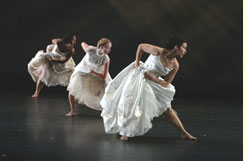
Vox Dance Theatre will perform Sarah Swenson’s classic Fimmine, which is usually performed in flowing white wedding gowns in the western tradition. In this new venue, colorful traditional wedding kimonos will be worn instead, loaned to Vox Dance Theatre by the JACCC especially for this event.

Vox Dance Theatre is honored to be part of the Festival of Sacred Music, and to lend its unique perspective on this exciting exploration of the blending of world arts and cultures.

The Festival takes place at various venues throughout the greater Los Angeles area and extends from the first of October through the sixteenth. Mare Vaporum will be performed from 8:00 to 10:00 PM on the last night of the Festival. For more information, go to www.festivalofsacredmusic.org/event/mare-vaporum.


NEWS AND NOTES ON DANCERS

Tamsin Carlson, Associate Artistic Director, was a member of RUG (Repertory Understudy Group) for the Merce Cunningham Dance Company from 1996 to 1999, and is a member of the Cunningham School faculty. From 1999-2000 she performed with Lucinda Child's 25th anniversary tour, and also worked with Jonathon Appels, Charemaine Seet, Ellen Van Schylenburch and Beth Soll. Tamsin is a graduate of The Arts Educational School and London Contemporary Dance School. She is honored to be working with Rudy Perez as a member of his ensemble since moving to Los Angeles in 2000. Tamsin joined Vox Dance Theatre in 2004.

Hope Bataclan, a native of Florida, began her dance training in Tampa and continued her studies at the University of California, Irvine. There, she was a member of Donald McKayle's Etude Ensemble and Sheron Wray's Insight Jazz Dance Ensemble. She graduated in the spring of 2011 with a B.F.A in Dance Performance. Hope joined Vox Dance Theatre in 2011.

Erin Bond is originally from Las Vegas, NV, where she trained with Nevada Ballet Theatre as an apprentice and attended Las Vegas Academy of the Performing Arts High School. She then graduated from Chapman University Summa Cum Laude with a BFA in Dance Performance, where she also received the Outstanding Performance Award. Since graduation, she has had the opportunity to perform with several contemporary and modern dance choreographers in the greater LA area, including Alex Little and Sean Greene with Gaulimaufry and Greene. Erin joined Vox Dance Theatre this year.

Amainary Contreras began her dance training at the age of four at the Gabriella Axelrad Education Foundation program, Everybody Dance. From that moment she discovered her passion for dance and knew that it was what she wanted to pursue. She is fortunate to have studied with some of the best dance instructors including Vera Nickovich, Shannon Harris and many others. She is grateful to Everybody Dance for offering her excellent dance training in various dance forms, in addition to the opportunity to work with Method Contemporary Dance and other dance professionals. Amainary is currently a sophomore at the Los Angeles County High School for the Arts, and is greatly honored to be a member of Vox Dance Theatre.

Katrina Obarski started dancing at age five and decided to go pro seven years later during her first performance in Tchaikovsky's The Nutcracker. She trained and performed with the Delaware Dance Company and Sara Taylor-Warner's Mid-Atlantic Ballet through high school. From there, she switched her focus to modern dance as she began her tenure at Goucher College. In her four years at Goucher, she worked with several visiting dancers and choreographers including Christopher D'Amboise, Michael Uthoff, Kathleen Hermesdorf, Kevin Iega Jeff, Kim Epifano, Adrienne Clancy and Stephanie Powell. She also spent 4 months in England studying with such dancers and scholars as Anne Went and Alexandra Carter. She's elated to be performing with Vox Dance Theatre and she'd like to thank her parents, John and Cindy Mulvey, for their continuing love and support, Renee Brozic Barger, Sara Taylor-Neal, Sunshine Webster-Latshaw, and the dance faculty of Goucher College. Katrina joined Vox Dance Theatre in 2004.

Katy Tabb graduated Magna Cum Laude with a B.A. in Dance from Chapman University where she was awarded an Outstanding Performance Award. Since graduation, Katy has worked with Benita Bike's DanceArt, Vox Dance Theatre, and Kybele Dance Theater as a company member. Katy has had the opportunity to work with contemporary and modern dance choreographers in the Los Angeles area including Denai Lovrien, Alex Little, and Sean Greene and has performed in several regional musical theater productions across the United States. Katy is a proud co-founder of the Core Collective, a platform for emerging dancers, choreographers, and artists to engage new audiences in dance, which she formed with Napoleon Gladney in the summer of 2010. She joined Vox Dance Theatre this year.